Most ERP partners I talk to know their product inside and out. They can walk a prospect through every module, explain the implementation process in detail, and answer technical questions on the spot. And they still lose deals to partners who know less about the software.
That’s a frustrating reality, but it points to something important: in B2B sales, being the most knowledgeable person in the room is not the same as being the most compelling one. Especially in the ERP space, where multiple VARs are often pitching the same product to the same prospect.
What separates the partners who close is usually not what they know. It’s how they tell their story.
Why Features Don’t Sell ERP Solutions
No matter which systems you sell, something I’ve observed with all VARs and ISVs: the moment you lead with a feature list, you’ve already lost the room. Not because the features aren’t impressive, but because your prospect doesn’t experience your software through a feature list. They experience it through their business problems.
A CFO at a mid-size manufacturer is not thinking “I need multi-entity financial consolidation.” They’re thinking “I spend three days every month-end close trying to reconcile numbers that should just be there.” Those are very different conversations, and only one of them leads anywhere.
The shift from feature-first to story-first is not about dumbing anything down. It’s about meeting your prospects where they actually are.
And here’s the part that should get every VAR’s attention: according to Gartner, B2B buyers spend only 17% of their total buying time meeting with potential vendors. That means the other 83% of the journey happens without you in the room. Your content, your case studies, your blog posts, your LinkedIn presence, all that stuff is doing the selling while your team is busy with everything else. If that content leads with features, it’s not doing a good job.
What B2B Storytelling Actually Looks Like
When I say storytelling, I don’t mean crafting a corporate narrative or writing a brand manifesto. For a VAR or ISV, storytelling is far more practical than that. It’s the difference between saying “we have deep manufacturing experience” and saying “we’ve implemented ERP for manufacturers across the Midwest, and the number one thing they all had in common was a production scheduling process held together with spreadsheets and internal knowledge.”
One of those statements is forgettable. The other one makes a prospect lean forward and want to learn more.
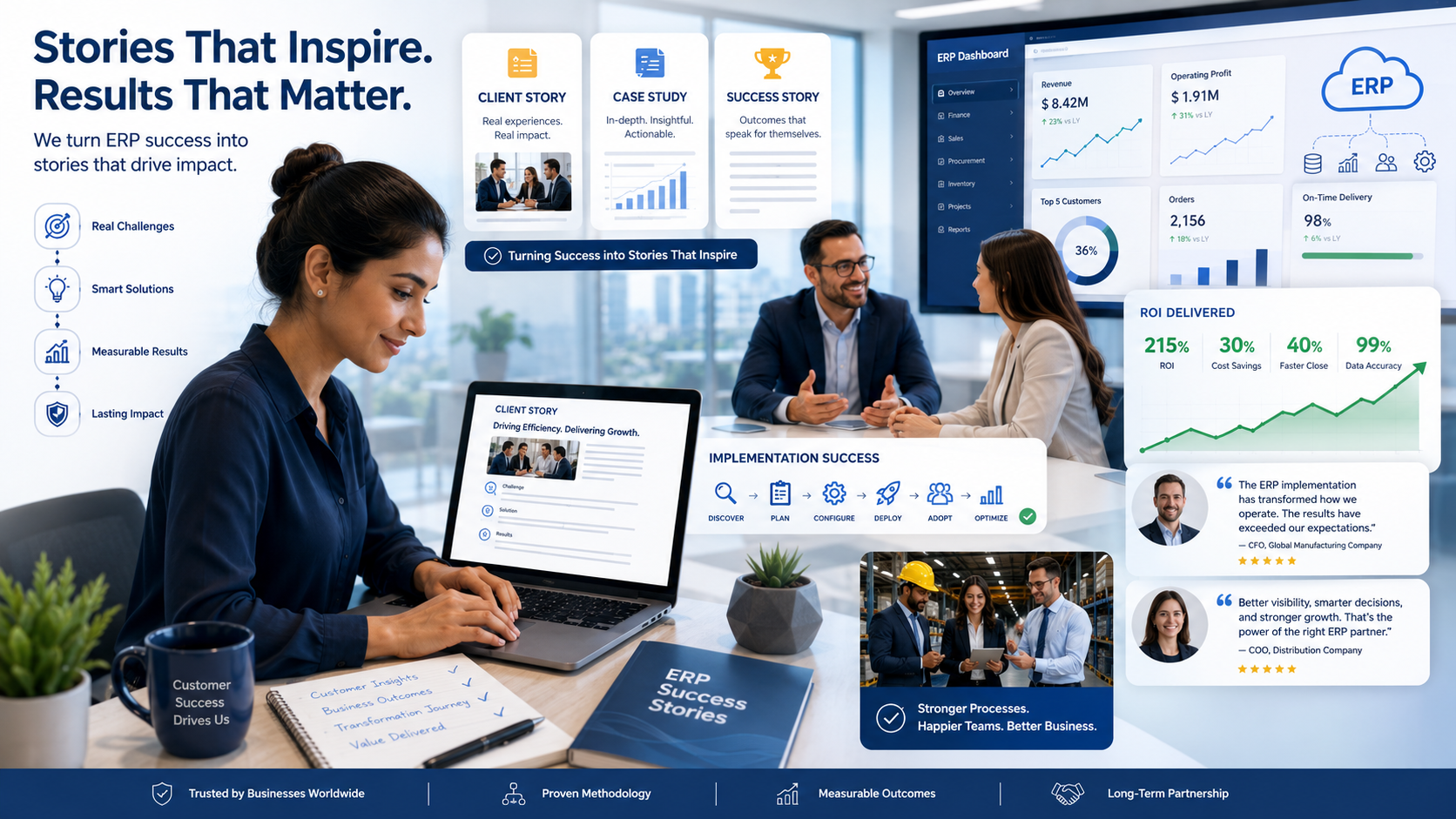
The most effective B2B stories for ERP partners follow a simple pattern: here’s the situation a client was in, here’s what was actually broken, here’s what changed after implementation, and here’s the number that proves it. That structure works in blog posts, in sales conversations, in LinkedIn content, and even in email outreach. It works because it gives your prospect a mirror to hold up against their own business.
Here’s What Most VARs Get Wrong
The most common mistake I see is VARs telling stories about themselves instead of stories about their clients. “We’ve been an Acumatica partner since 2014” is about you. “We helped a Chicago-based distributor cut their month-end close from 12 days to 4 after moving off their legacy system” is about an outcome your prospect wants.
The other mistake is keeping good stories locked inside the team. If your best implementation stories only live in a salesperson or consultant’s head, they’re doing a fraction of the work they could be doing. A well-written case study, a blog post that walks through a real client scenario, a specific LinkedIn post that describes a problem you solved last quarter: all of these assets work for you around the clock, not just when a rep is on a call.
Practical Ways to Build Your Story Library
You don’t need a content team or a big budget to start building stories that sell. You need a habit of capturing them. After every go-live, ask your client three questions: What was the biggest pain before implementation? What surprised them most about the process? What would they tell another business owner who was on the fence? Those answers are your content.
Case studies are the obvious output, but they’re not the only ones. Short blog posts that walk through a single problem and how it was solved, LinkedIn posts that share one specific insight from a recent project, email subject lines that reference a recognizable scenario. All of it builds the kind of credibility that a feature list never will.
The goal is to give your prospects examples that they recognize in their own business before they even talk to you. That way, the first conversation your team has is a very different one. They’re not introducing themselves. They’re confirming what the prospect already suspects: that you understand their world.
Your Story Is Already There
If you’ve been implementing ERP for any length of time, you have more compelling material than most marketing agencies could invent. The challenge isn’t generating stories. It’s developing the discipline to capture, structure, and publish them consistently.
That’s where most VARs get stuck. Not for lack of good content, but for lack of time and a repeatable process. If you want help building a content strategy around the stories you already have, that’s exactly what we do.
Let’s talk about what your stories could look like. Contact KMG today.
Krizik Marketing Group is a B2B marketing agency specializing in ERP VARs, ISVs, and technology partners. With over 30 years of experience in the ERP channel, KMG helps Acumatica and Microsoft Dynamics partners build content strategies, generate leads, and grow their pipeline.
Recent Comments